
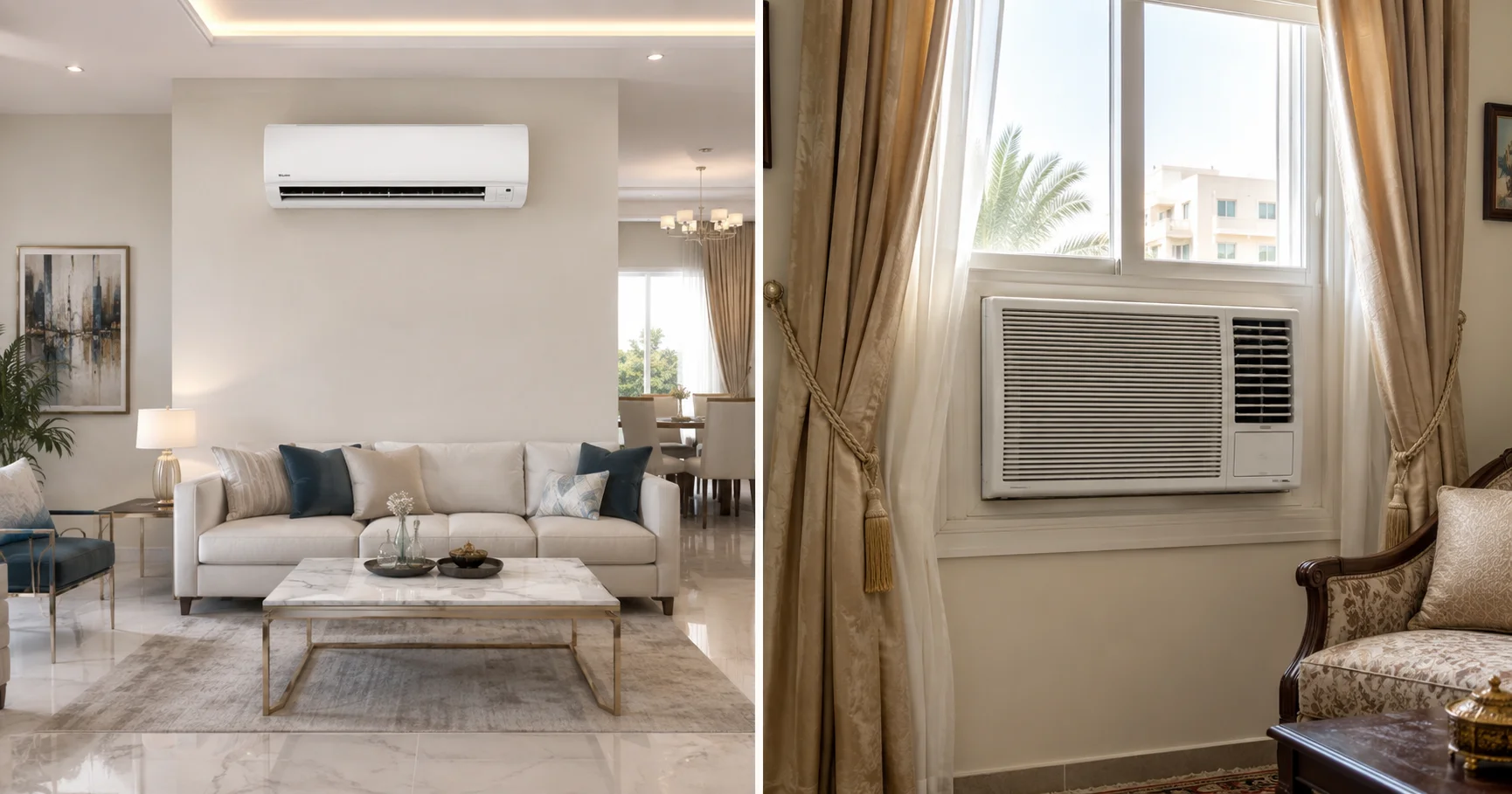
Most people in Bahrain make this decision based on price alone. They see a window AC for a fraction of what a split costs, they buy it, and six months later they are either dealing with higher electricity bills than expected or a unit that cannot keep up when the temperature outside hits 45°C at 2pm in August.
I have repaired both types for years across Bahrain. The question of which is better is not a simple one, and anyone who gives you a one-line answer is leaving out the parts that actually matter for this market specifically. The electricity tariff situation here, the building restrictions in newer developments, the way Bahrain’s dust and humidity affect each type differently over time none of that appears in generic split vs window AC comparisons written for India or the UK.
This guide is written for Bahrain. Homeowners, renters, villa residents, apartment dwellers. All of it covered.
The Core Difference Between Split AC and Window AC What Actually Matters
How a Split AC Works and Why the Two-Unit Design Changes Everything
A split AC separates the noisy, heat-generating compressor from the part of the system you live with indoors. The outdoor unit handles the compressor and condenser the components that generate heat and vibration. The indoor unit contains only the evaporator coil and blower fan, which circulate cold air quietly through the room.
That separation is not just about noise. It means the compressor operates in the open air where heat can dissipate properly, rather than fighting against itself inside a sealed box. In Bahrain’s summer heat, that distinction matters enormously. A compressor that can breathe and dissipate heat outdoors runs more efficiently and lasts longer than one trapped in a single unit trying to stay cool in a 40°C room.
How a Window AC Works and Where Its Single-Unit Design Helps and Hurts
A window AC puts every component compressor, condenser, evaporator, and fan into one box that sits in a window frame or wall opening. Everything is in one place, which makes installation simple and the upfront cost low.
But that same design creates a problem in high-temperature environments. The condenser side of a window AC faces outdoors and needs to release heat. When outdoor temperatures exceed 40°C, the condenser struggles to reject heat efficiently. The compressor works harder to compensate. The harder the compressor works in sustained heat, the faster it degrades.
Not always immediately. But over time, consistently.
The One Question That Decides Everything Before Comparing Anything Else
Before comparing cooling output, noise levels, or energy ratings, there is one question every Bahrain resident needs to answer first: are you staying in this property for more than two years?
If the answer is yes, the calculation almost always favours a split AC. If the answer is no, a window unit might make more practical sense regardless of efficiency differences. The rest of this guide helps you understand why, with specifics that apply to Bahrain rather than a generic market.
Cooling Performance in Bahrain’s Extreme Climate
How Each AC Type Handles 45°C Outdoor Temperatures
Split ACs maintain stable indoor temperatures more reliably in Bahrain’s peak summer heat than window units of equivalent capacity. The reason comes back to the compressor placement. With the compressor outdoors, a split AC’s refrigerant circuit operates under more stable conditions even when outdoor temperatures are extreme. The indoor unit delivers consistent cooling without the compressor heat interfering with the process.
A window AC in the same conditions is doing something fundamentally harder. The hot outdoor air surrounding the condenser reduces the temperature differential the refrigerant can work with. Cooling efficiency drops. The unit runs longer to achieve the same result.
Why Split ACs Maintain Stable Indoor Temperatures Better During Bahrain’s Peak Summer
The inverter technology available in most modern split ACs is a significant part of this. An inverter split AC adjusts its compressor speed continuously rather than cycling fully on and fully off. In practical terms, this means the indoor temperature stays within one or two degrees of the set point rather than swinging several degrees between cycles.
In a Bahrain summer, that consistency matters for comfort in a way that is hard to explain until you have experienced it. A room that cycles between 22°C and 26°C because of a fixed-speed compressor feels different from one that holds steady at 23°C. The inverter split AC holds steady. Most window ACs cannot do this because inverter technology is far less common in window unit designs.
When a Window AC Genuinely Keeps Up
For a small room under 15 square metres used occasionally a spare bedroom, a storage room with a workbench, a utility space a window AC can cool the area without struggling. The load is manageable. The runtime is shorter. The compressor is not fighting a large thermal mass.
This is where window AC units earn their place honestly. They are not bad units. They are just designed for a specific use case, and in Bahrain’s climate, that use case is narrower than the low purchase price makes people think.
Humidity and Coastal Air What Manama, Juffair, and Muharraq Residents Need to Know
Coastal areas of Bahrain deal with significant humidity for much of the year. An AC unit removes moisture from the air as part of the cooling process, but how well it does this depends on how much time the air spends in contact with the evaporator coil. Split ACs with properly sized evaporator coils remove humidity more effectively than most window units because the indoor coil is larger relative to the overall unit size.
In a humid Juffair apartment or a coastal villa in Muharraq, this difference shows in comfort. A room cooled by a well-sized split AC feels genuinely dry and comfortable. A room with a window unit at the same temperature can still feel sticky because the humidity removal is less effective.
Energy Consumption and Electricity Costs in Bahrain
Bahrain’s Electricity Tariff Reality
Bahrain removed electricity subsidies for expatriates and adjusted tariffs for nationals over time. The residential tariff structure means that heavy electricity users pay progressively more per unit. A household running multiple window ACs for 12 to 16 hours a day in summer will hit higher tariff brackets faster than one running properly sized inverter split ACs.
I am not going to invent a number here because tariffs have changed and vary by consumption band. But the direction is clear. Bahrain’s electricity is not free, and the efficiency difference between an inverter split AC and a fixed-speed window AC compounds significantly over a full Bahrain cooling season which runs from roughly April through October.
Inverter Split AC vs Non-Inverter Window AC
The efficiency gap between a modern inverter split AC and a standard window AC is real and consistent. An inverter compressor adjusts its speed to match the cooling demand. It does not switch fully off and restart repeatedly. Each full restart draws a surge of current that adds to the running cost. A standard window AC without inverter technology restarts many times per hour in a hot Bahrain room, and each restart costs more than continuous operation at reduced speed would.
The practical result is that an inverter split AC typically uses meaningfully less electricity than a non-inverter window unit cooling the same space. Over six to seven months of Bahrain’s cooling season, that difference adds up to a number that starts closing the gap on the higher purchase price of the split.
How Many Hours Per Day Does Your AC Run in Bahrain?
This is the calculation most people skip. In a mild climate, an AC might run four to six hours a day. In Bahrain from June through August, a unit cooling a well-insulated room might run ten to fourteen hours. In a poorly insulated apartment on a top floor with western sun exposure, continuous operation is not unusual.
At ten to fourteen hours of daily operation, energy efficiency matters far more than it would at four hours. The efficiency advantage of a split AC, measured in electricity cost per hour of operation, is multiplied by the sheer number of hours Bahrain demands from its cooling systems.
Which AC Type Pays for Itself Faster in Bahrain’s Long Cooling Season
A quality inverter split AC costs more upfront than a comparable window unit. That gap varies by brand and capacity, but it is real. The question is how long it takes the electricity savings to close that gap.
In Bahrain’s operating conditions, the energy savings from an inverter split AC start accumulating immediately in the first summer. For a primary room used daily, the payback period on the efficiency difference is shorter than most people expect because the usage hours are so high. For a room used occasionally, the window AC’s lower price remains the better financial decision simply because the efficiency savings never get the hours needed to compound.
Installation Costs and Building Restrictions in Bahrain
What Split AC Installation Actually Costs in Bahrain
Split AC installation involves mounting the indoor unit, placing and securing the outdoor unit, drilling through the wall for the refrigerant lines and drainage, insulating the piping run, and making the electrical connections. Professional installation is not optional. A poorly installed split AC with uninsulated pipe runs or improperly seated refrigerant connections will develop problems within one to two summers.
Installation cost in Bahrain varies by the complexity of the pipe run, the height of the outdoor unit placement, and whether electrical work beyond the standard connection is needed. Always get the installation quote separately from the unit price and confirm exactly what it includes before agreeing.
What Window AC Installation Costs and What Can Go Wrong
Window AC installation is simpler and cheaper. The unit slides into a prepared opening and the connections are straightforward. But I have seen window AC installations in Bahrain where the gap around the unit was not properly sealed, allowing hot outdoor air and dust to flow directly into the room around the edges of the unit. In Bahrain’s summer, that air infiltration kills cooling efficiency and adds real cost.
Sealing matters. If whoever installs the window AC does not seal the gap properly between the unit and the opening, the room will never cool as well as it should regardless of the unit’s capacity.
Building Rules in Bahrain Why Juffair, Amwaj, and Newer Developments Ban Window ACs
This is the factor that removes the choice entirely for a significant portion of Bahrain’s residential population. Many newer apartment buildings and residential developments in areas like Juffair, Amwaj Islands, Riffa Views, and parts of Seef have building management rules that prohibit window AC units specifically to preserve the external appearance of the building.
If you live in one of these developments and install a window AC unit, you may be required to remove it by the building management. Before purchasing any window unit for an apartment in Bahrain, check the building’s regulations. This is not a minor risk. I have seen tenants buy units, install them, and then have to remove them within weeks.
What Expatriate Renters Need to Know Before Choosing Either Type
The expatriate renter situation in Bahrain is specific. Many renters are here for a defined contract period, they cannot make permanent modifications to a rented property, and they want to minimise upfront costs on equipment they cannot take with them when they leave.
For a short-term rental in a building that permits window ACs, a window unit can be a reasonable decision. For a longer stay, even in a rental, the electricity cost difference over two or three Bahrain summers starts to matter. And if the building prohibits window units, the choice is already made.
Repair Costs and Common Failures Bahrain Specific
Which AC Type Breaks Down More Often in Bahrain’s Heat and Dust
Both types break down more often in Bahrain than manufacturers’ specifications suggest, because those specifications assume moderate operating environments. In Bahrain’s continuous high-heat operation with significant airborne dust, service intervals need to be shorter and fault rates are higher than you would see in temperate markets.
That said, window ACs show specific vulnerabilities in Bahrain’s climate that I see regularly. The condenser coil on a window AC faces the outdoor environment directly. In Bahrain’s dusty air, that coil blocks up faster than manufacturers anticipate. A heavily blocked condenser coil forces the compressor to work harder in heat that already demands maximum effort. The compressor wears faster.
Split AC Repair Costs in Bahrain What Faults Come Up Most
The most common split AC repair calls I attend in Bahrain are refrigerant leaks at the flare connections, evaporator fan motor failures, capacitor faults, and PCB sensor errors. These are all repairable faults where the cost of repair is a fraction of replacement. A split AC with a failed capacitor or a refrigerant leak at a joint does not need to be replaced. It needs a specific repair.
Compressor failures on split ACs do happen, but they are less common than on window units in Bahrain’s conditions because the split compressor sits outdoors with airflow around it rather than packed into a box surrounded by its own heat.
Window AC Repair Costs in Bahrain When Repair Makes Sense vs Replacement
Window AC repairs follow a different logic. Minor faults like thermostat problems, fan motor replacements, and condenser coil cleans are cost-effective repairs. But when the compressor fails on a window AC, the calculation changes. Compressor replacement on a window unit often costs a significant proportion of what a new unit would cost, and the repaired unit still has all the wear accumulated on the rest of its components.
My honest assessment: on a window AC more than three years old in Bahrain’s operating conditions with a failed compressor, replacement rather than repair is usually the better financial decision. On a split AC of similar age with a compressor fault, repair is almost always worth pursuing because the rest of the components are in a much better condition.
The Compressor Problem With Window ACs in Bahrain That Nobody Talks About
Every window AC compressor in Bahrain operates in the same sealed box as the condenser coil that is supposed to be releasing heat. When that condenser coil blocks up from dust which happens faster in Bahrain than in cleaner air environments the compressor starts running hotter than it should.
Compressors fail from heat. Not immediately, and not dramatically. The degradation is gradual. The motor windings break down. The oil inside the compressor loses its lubricating properties at elevated temperatures. Over two to three Bahrain summers with inadequate condenser cleaning, a window AC compressor that might have lasted eight years elsewhere fails at four or five years here.
Cleaning the condenser coil on a window AC at least once per year, and ideally twice during heavy usage seasons, is not optional maintenance in Bahrain. It is the difference between a unit that lasts and one that does not.
Which Type Is Cheaper to Maintain Over 5 Years in Bahrain
Split ACs cost more per service visit because servicing both units indoor and outdoor takes more time. But the fault rate is lower and the major repairs are less frequent. Window ACs cost less per service visit but need more frequent attention and hit major failures sooner.
Over a five-year period in Bahrain, the total maintenance and repair cost picture generally favours the split AC for any primary room in daily use. The lower fault rate and longer compressor lifespan offset the higher per-visit service cost.
Noise, Comfort, and Daily Living
Why Noise Matters More in Bahrain Than People Admit
In Bahrain, AC units run through the night for much of the year. This is not a situation where you switch the AC off before bed and open a window. From May through September, the AC runs overnight or the room becomes genuinely uncomfortable. An AC that is noisy enough to affect sleep quality is not a minor inconvenience in this climate. It is a problem that repeats every single night for months.
Split AC Noise Levels What to Expect Indoors vs Outdoors
The indoor unit of a split AC produces only fan noise, since the compressor is outside. Modern split AC indoor units are very quiet during normal operation. At night mode or low fan speed, many people cannot hear them from across the room.
The outdoor compressor unit makes more noise, but it faces the exterior of the building. In most Bahrain apartments and villas, the outdoor unit is either on a balcony, a roof, or an exterior wall bracket where the noise travels away from the living space. Neighbours directly adjacent to the outdoor unit placement should be considered during installation planning, but indoor occupants are generally unaffected.
Window AC Noise The Compressor Problem in Apartments and Villas
Every window AC runs the compressor in the same box as the indoor fan. When the compressor cycles on, you hear it. In a quiet bedroom at night, that compressor click and the subsequent change in vibration level is noticeable. Older window units or units with worn compressor mounts become progressively louder as they age.
I have had customers in Bahrain tell me they moved the window AC to a different room because they could not sleep next to it. That is a real outcome that the purchase price comparison does not capture.
Sleep Quality, Bedroom Comfort, and Which Type Wins for Night-Time Use
For bedrooms, a split AC is clearly the better choice in Bahrain. The combination of quiet indoor operation, stable temperature maintenance from inverter technology, and reliable overnight performance without the noise spikes of a cycling window compressor makes the sleep environment substantially better.
This is not a close comparison for bedrooms. It is straightforward.
Lifespan and Long-Term Value in Bahrain
How Long Does a Split AC Last in Bahrain’s Climate?
A well-maintained split AC in Bahrain typically lasts eight to twelve years before the compressor or major components require replacement. The outdoor compressor benefits from airflow around it, which keeps operating temperatures lower than a window unit’s compressor. Regular servicing filter cleaning, condenser coil cleaning on the outdoor unit, refrigerant level checks extends that lifespan toward the higher end of the range.
How Long Does a Window AC Last Under Bahrain’s Operating Conditions?
A window AC in Bahrain typically lasts five to eight years with proper maintenance. Without regular condenser coil cleaning, that range drops noticeably. The combination of continuous high-load operation, elevated compressor temperatures from the sealed single-unit design, and Bahrain’s airborne dust load all accelerate wear.
Five years is not a short lifespan for any appliance. But when you factor in the replacement cost and the installation process, replacing a window AC every five to six years adds up over time.
What Continuous Summer Operation Does to Each AC Type Over Time
Any AC running ten to fourteen hours per day for six to seven months accumulates roughly 1,800 to 2,500 operating hours per year in Bahrain’s climate. Most AC components are rated for service intervals and lifespans based on average global usage, which is substantially lower than that.
The split AC handles this better because the workload is distributed across components that have better thermal management. The window AC concentrates that workload into a single unit where heat accumulates and is harder to manage.
Which Gives Better Value Over a 5 to 10 Year Period in Bahrain
For a primary room in daily use, the split AC delivers better total value over five to ten years in Bahrain. The higher purchase and installation cost is offset by lower electricity consumption, lower repair frequency, and longer lifespan. The total cost of ownership over a decade favours the split AC consistently.
For occasional-use rooms where the AC runs a few hours a day at most, the window AC’s lower upfront cost and simpler maintenance may represent better value simply because the usage hours are too low for the efficiency savings to compound meaningfully.
Who Should Choose a Split AC in Bahrain
Villa and Apartment Owners Planning Long-Term Residence
If you own your property in Bahrain or have a lease running two years or more, a split AC is almost always the right investment for any room you use regularly. The efficiency savings, the longer lifespan, the lower repair frequency, and the better comfort all favour the split system when you have enough time in the property to benefit from them.
The higher upfront cost is real. But it is a one-time cost that pays back over time in multiple ways.
Large Rooms, Open-Plan Spaces, and Multi-Room Cooling Needs
Split ACs are the only practical choice for large living rooms, open-plan kitchen and dining areas, and any space over roughly 20 square metres. Window ACs struggle with large spaces in Bahrain’s heat. A window unit might cool the area near the unit adequately while the far end of the room stays warm. A properly sized split AC distributes cool air more evenly across larger spaces.
Anyone in a Building That Prohibits Window Units
This one is straightforward. If your building management does not permit window AC units, you have no choice. Check before you buy anything.
Families Prioritising Quiet Operation and Energy Savings
For families with children, for anyone who works from home, for anyone who values uninterrupted sleep during Bahrain’s long summer nights, the quiet operation of a split AC makes a daily quality-of-life difference that the purchase price comparison does not reflect.
Who Should Choose a Window AC in Bahrain
Short-Term Expatriate Renters Who Cannot Modify Walls
If you are in Bahrain for a one-year contract in a furnished apartment that is already missing AC coverage in one room, and your building permits window units, a window AC is a practical temporary solution. You are not making a long-term investment. You need cooling for a defined period and the lower upfront cost makes sense.
Small Single Rooms, Spare Bedrooms, and Utility Spaces
A storeroom that doubles as a home office for occasional use, a spare bedroom used by visiting family a few weeks per year, a small utility room these are legitimate use cases for window ACs in Bahrain. The cooling demand is low enough that the efficiency disadvantage is not significant and the compressor load stays manageable.
Tight Upfront Budget With a Clear Short-Term Stay
Budget is real. Not everyone can absorb the higher cost of a split AC plus installation right now. If the choice is between a window AC this summer and suffering through the heat while saving for a split system next year, the window AC is the right short-term call. Just commit to the condenser coil cleaning.
Situations Where a Window AC Is Genuinely the Smarter Call
There are rooms in Bahrain where wall construction, building structure, or lack of exterior access makes split AC installation genuinely impractical or very expensive. In those specific cases, a window unit is the practical solution rather than a budget compromise.
Brand Comparison Which AC Brands Work Best in Bahrain
Best Split AC Brands Available in Bahrain
The brands I see performing most reliably in Bahrain’s conditions are Daikin, Samsung, LG, and Carrier. Daikin has a strong reputation for compressor longevity and its inverter technology is well established. Samsung and LG have good parts availability in Bahrain, which matters when repairs are needed. Carrier’s commercial and residential systems are common in Bahrain’s office and villa market.
Gree and Midea offer competitive pricing and are increasingly common in newer residential builds. Parts availability for both has improved significantly in Bahrain over the past few years.
Best Window AC Brands in Bahrain
For window ACs, LG and General are the brands I most commonly repair and see performing reliably in Bahrain. Sharp and Haier have presence in the market and parts are generally available. General, despite not being as widely marketed as some brands, has strong units that handle Bahrain’s operating demands reasonably well.
Which Brands Have the Best Parts Availability for Repairs in Bahrain
Parts availability matters in Bahrain because some brands distribute through limited channels and sourcing specific components takes weeks. Samsung, LG, Daikin, and Carrier all have established supply chains into Bahrain. For less common brands, confirm parts availability with a local technician before purchasing the unit, not after it develops a fault.
Inverter vs Non-Inverter Why This Matters More in Bahrain Than Brand Name
Whatever brand you choose, prioritise inverter technology over brand name for any primary room. The operating efficiency difference between an inverter and non-inverter compressor, multiplied by Bahrain’s annual operating hours, is more significant than the brand reputation difference between most mainstream options.
An inverter LG beats a non-inverter Daikin in Bahrain’s operating economics every time. Not because LG is better than Daikin, but because the inverter technology matters more than the badge when the unit is running twelve hours a day.
Split AC vs Window AC Side-by-Side Comparison Table
| Feature | Split AC | Window AC |
|---|---|---|
| Cooling performance | Excellent, consistent | Good for small rooms |
| Indoor noise | Very quiet | Noticeable compressor noise |
| Energy efficiency | High, especially with inverter | Moderate to low |
| Installation cost | Higher | Lower |
| Upfront unit cost | Higher | Lower |
| Repair cost per visit | Moderate | Lower |
| Compressor lifespan in Bahrain | 8 to 12 years | 5 to 8 years |
| Suitable room size | Any size | Up to roughly 20 sqm |
| Building restrictions | No restrictions | Prohibited in many buildings |
| Best for | Owners, long-term residents | Renters, small spaces, short stays |
| Maintenance frequency | Every 6 months | Every 3 to 4 months in Bahrain |
| Humidity removal | Better | Adequate for small rooms |
Repair and Maintenance Tips Specific to Each Type in Bahrain
How Often to Service a Split AC in Bahrain
Every six months is the right interval for a split AC in Bahrain. Before summer starts March or April and once during the cooling season around July or August. Each service should include filter cleaning on the indoor unit, condenser coil inspection and cleaning on the outdoor unit, condensate drain flushing, refrigerant pressure check, and electrical connection inspection.
The filter cleaning can be done more frequently by the homeowner without a technician. Every four to six weeks during heavy summer use is reasonable.
How Often to Service a Window AC in Bahrain
Window ACs in Bahrain need more frequent attention than split ACs. The condenser coil accumulates dust faster because of its direct outdoor exposure. A full service every three to four months during the cooling season is not excessive. At minimum, the condenser coil should be cleaned once before summer and once during it.
The Condenser Coil Cleaning Problem in Bahrain’s Dusty Environment
This is the maintenance task that most Bahrain AC owners skip and then wonder why their unit is underperforming or failing early. Bahrain’s combination of fine desert dust, construction dust in many areas, and sea spray in coastal zones creates a particularly aggressive coating on condenser coils.
A split AC’s outdoor unit condenser is accessible and relatively straightforward to clean. A window AC’s condenser is on the outdoor-facing side of the unit and requires either removing the unit from the wall or using a technician with appropriate tools to reach and clean it properly.
Signs Your Split AC Needs Repair Before It Breaks Down Completely
The warning signs I tell every customer to watch for are reduced cooling despite the unit running normally, unusual noise from either the indoor or outdoor unit, water leaking from the indoor unit onto the wall, ice forming on the indoor unit, and the unit running constantly without reaching the set temperature.
Any of these means something is developing that will become a larger fault if ignored. Catching it early almost always means a cheaper repair.
Signs Your Window AC Is Approaching the End of Its Repair Life
A window AC that runs constantly without cooling adequately, makes grinding or clicking sounds during operation, leaks water into the room rather than draining outside, or trips the circuit breaker repeatedly is showing signs of compressor or electrical deterioration. At that point, get an honest assessment of repair cost versus replacement cost before spending money on repairs.
Frequently Asked Questions
Which AC Is Better for a Bahrain Villa Split or Window?
For a Bahrain villa, a split AC is almost always the better choice. Villas typically have larger rooms than apartments, higher ceilings, and more sun exposure, all of which increase cooling demand beyond what window units handle comfortably. The longer lifespan and better energy efficiency of a split system also make more sense for villa owners who are investing in the property long term.
Do Split ACs Save Electricity in Bahrain Compared to Window ACs?
Yes, meaningfully so for rooms in daily use. The inverter technology in most modern split ACs reduces electricity consumption compared to the fixed-speed compressors in standard window units. In Bahrain’s long cooling season with high daily operating hours, this difference accumulates to a real electricity cost saving that partially offsets the higher purchase price of the split system.
Can I Install a Window AC in a Bahrain Apartment?
It depends entirely on your building. Many newer residential developments in Bahrain, particularly in Juffair, Amwaj, Riffa Views, and parts of Seef, prohibit window AC units in their building regulations. Check with your building management before purchasing. Installing a prohibited unit and then being required to remove it is an expensive mistake.
How Much Does a Split AC Cost to Run Per Month in Bahrain?
Running cost depends on the unit’s capacity, its energy efficiency rating, your room’s insulation, how many hours per day you run it, and which electricity tariff band you fall into. A properly sized inverter split AC in an average Bahraini apartment room runs substantially cheaper per month than a non-inverter window AC cooling the same space. For a precise estimate, check the unit’s power consumption rating and multiply by your local electricity tariff and daily operating hours.
Which AC Type Breaks Down More Often in Bahrain’s Summer?
Window ACs break down more frequently than split ACs in Bahrain’s operating conditions. The combination of continuous high-load operation in extreme heat, compressor heat accumulation in the single-unit design, and faster condenser coil blocking from Bahrain’s dust creates a higher fault rate. Split ACs experience faults too, but the fault rate is lower and the faults that do occur tend to be less severe.
Is It Worth Repairing a Window AC in Bahrain or Just Replacing It?
For a window AC under three years old with a minor fault, repair is sensible. For a window AC over five years old with a compressor fault, replacement often makes more financial sense than repair. The compressor replacement cost on a window unit is high relative to the price of a new unit, and a repaired compressor in an otherwise worn unit does not restore the overall lifespan you might hope for.
What Size Split AC Do I Need for a Typical Bahrain Room?
For a standard bedroom of 12 to 16 square metres with average insulation, a 1 to 1.5 tonne split AC is appropriate. For a living room of 25 to 35 square metres, 2 tonnes is usually the minimum. Bahrain’s extreme heat means you should not undersize the unit a system that is too small for the space will run continuously without maintaining the desired temperature and will wear out faster.
How Long Does a Split AC Last in Bahrain?
A well-maintained split AC in Bahrain typically lasts eight to twelve years. Regular servicing twice per year, prompt attention to early fault signs, and a voltage stabiliser to protect against power fluctuations all push the lifespan toward the higher end of that range. Skipping maintenance consistently brings it toward the lower end.
Contact Al Hafiz Electronics for AC Repair in Bahrain
Whether you have a split AC or a window AC that needs attention, Al Hafiz Electronics services both across all five governorates of Bahrain. Call or WhatsApp +973 3591 3202 for a same-day or emergency repair visit.
Written quote before any work starts. 90-day warranty on every completed repair. Genuine 24/7 emergency service for situations that cannot wait.
If you are still deciding between a split AC and a window AC for a specific room and want an honest assessment based on your actual situation, call before you buy. The right unit for your room, your building, and your length of stay will save you money and the wrong one will cost you more than the purchase price difference suggests.